Outline a new workspace
Ready to start
Product · DesignBeadalac · Task management for the agentic era
Organize projects and people. Move a task to start the workflow that carries it from intent into execution.
See the work in motion ↓ Demo data
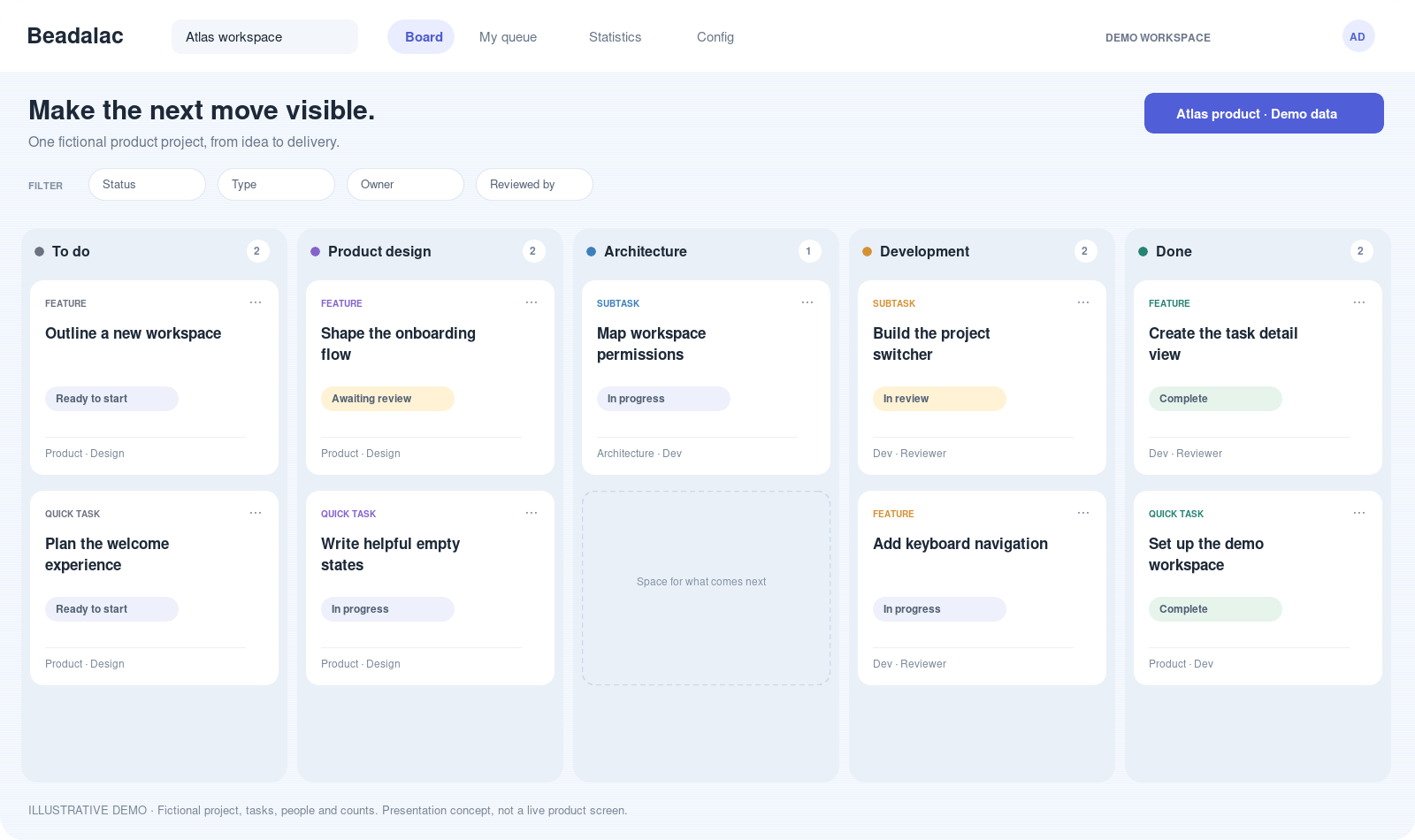
Explore the demo board · Swipe stages →
Ready to start
Product · DesignReady to start
Product · DesignAwaiting review
Product · DesignIn progress
Product · DesignIn progress
Architecture · DevIn review
Dev · ReviewerIn progress
Dev · ReviewerComplete
Dev · ReviewerComplete
Product · DevFrom a card to a clear brief
Start with the outcome. Beadalac develops the task in detail and raises questions where requests may conflict with other work or existing behavior.
Help a new teammate join the right workspace.
Current members retain their existing access.
Invitation rights, new-member role and expiry behavior.
Another task changes workspace roles. Resolve that choice before building against the wrong rules.
Illustrative task-detail composition. It explains the workflow, not a claim about exact implemented fields or notification controls.
Large tasks, workable pieces
When a task is too large, Beadalac splits it into smaller tasks with dependencies. The work gets smaller. The intent stays connected.
Preserve existing workspace access.
Who can invite? Which role is granted?
Starting taskBuild against the agreed invitation rules.
Depends on 01Complete the invitation lifecycle.
Depends on 02Check the new flow and existing access.
Depends on 01, 02 and 03Fictional software example. The task names and dependency chain are illustrative, not a fixed planning algorithm.
Execution with context
The software workflow connects product definition, architecture, development and QA, with attention to security, efficiency and codebase complexity.
The same invitation request supplies the questions to examine.
Can the intended teammate accept?
What happens when an invitation expires?
Do existing members keep their access?
Conceptual review scene, not an actual test report or claim that these checks passed.
A home for the whole project
Keep a backlog across multiple projects. Bring in people with different roles. Moving a task starts the workflow, rather than only changing its label.
Fictional product initiative
Fictional second project
Bring the intended outcome.
Develop what success means.
Fit the change to the system.
Illustrative organization of work, not an exact permissions matrix.
Both belong in the story. Beadalac combines a backlog, multiple projects and users with different roles with an agentic workflow started by moving a task. The detailed software workflow includes product definition, architecture, development and QA. The product category is task management for the agentic era; SDLC explains one execution workflow in depth.
A task is more than something to assign and track. You can define work in a backlog, organize it across projects and move a task to start the workflow. That workflow develops the request, raises questions where decisions may conflict and carries software work through architecture, development and QA.
The described workflow includes developing the task in detail with the thinking of an experienced product owner. You bring the outcome and the context you have. The workflow works through the task definition and raises questions where decisions or requirements need attention.
Product direction, conflicting requirements and meaningful tradeoffs still need judgment. Beadalac raises questions when requests or decisions may not align.
Yes. Tasks can range from small fixes to larger initiatives. When Beadalac finds that a task is too large, it splits it into separate smaller tasks with dependencies so the work can be completed in connected pieces.
In the described software workflow, requests are considered alongside other tasks and existing functionality. When they may not align, Beadalac raises a question.
The described scope is broader than producing code. It includes developing the task, architecture, development and QA, with security, efficiency and codebase size considered along the way. Code generation is a part of that work, not the definition of the whole product.
Start with what needs to change. Keep the definition, questions, execution and quality checks connected to the task.